


Syllabus: GS2/ Governance, GS3/ Science and Technology
Context
- The 3rd International Bharat 6G Symposium 2026 concluded in New Delhi.
About
- Organised by the Bharat 6G Alliance (B6GA) alongside India Mobile Congress 2026, the three-day event brought together global telecom leaders, industry, academia and researchers to discuss the roadmap towards IMT-2030 and beyond.
- A key outcome was the exchange of five new MoUs with GSMA, one6G, GTI Alliance, 6G Innovation Forum (6G IF) Taiwan and VOICE, strengthening opportunities for international cooperation.
What is 6G?
- 6G, or sixth-generation wireless technology, will succeed 5G and make internet connections significantly faster and smoother.
- 6G aims to send and receive information in just one microsecond; that’s 1,000 times faster than the response time of 5G.
- The 6G Technology has been named ‘IMT 2030’ by the International Telecommunication Union (ITU).
- IMT-2030 stands for International Mobile Telecommunications for 2030.
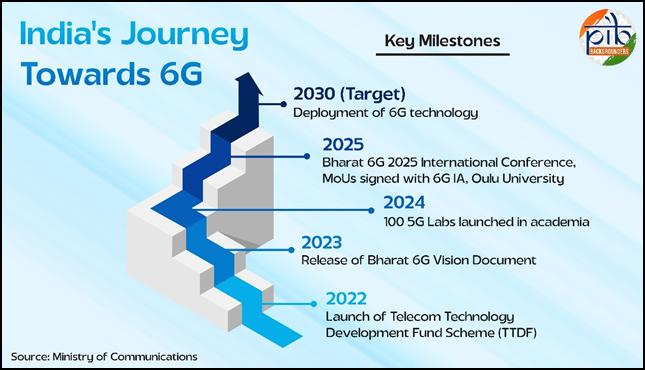
Bharat’s 6G Mission
- India’s pursuit of 6G began with an ambitious vision to become a global leader in next-generation wireless communications.
- This vision has driven the emergence of a dynamic ecosystem of innovators, researchers, startups, and policymakers, all dedicated to advancing connectivity.
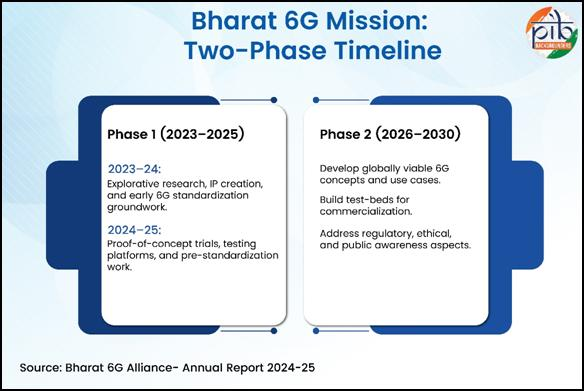
About Bharat 6G Alliance
- Established in 2023, Bharat 6G Alliance is an industry-led collaborative platform bringing together telecom service providers, industry, startups, academia and research institutions to advance India’s 6G ambitions.
- It promotes indigenous research and innovation, intellectual property creation, international standards engagement and partnerships for an affordable, secure, sustainable and globally interoperable 6G ecosystem.
Initiative for the Development of 6G Technology
- The Government established 100 5G labs at academic institutions across India for capacity building & for building a 6G-ready academic and start-up ecosystem in the country.
- Telecom Technology Development Fund (TTDF) Scheme was launched in 2022 to fund R&D and innovation in telecom technologies including 6G, fostering collaboration between academia, start-ups, MSMEs, research institutes, and industry to enhance the telecom ecosystem in India.
- Technology Innovation Hub at IIIT-Bangalore: Under the National Mission on Interdisciplinary Cyber-Physical Systems (NM-ICPS), a Technology Innovation Hub has been established at IIIT Bangalore, with a focus on Advanced Communication Systems that will shape future 6G networks.
Significance of 6G Vision
- The 6G technology will enable advancements in sectors like;
- Healthcare: Telemedicine, robotic surgeries, AI-based diagnostics.
- Agriculture: Smart monitoring, precision farming using IoT sensors.
- Education: Real-time immersive learning through AR/VR technologies.
- Industrial Automation: Leveraging Industry 4.0 with enhanced Machine-to-Machine communication, Digital Twins, and IoT for smart industries.
Challenges
- There is a need for R&D investments with a focus on semiconductors, AI processors, and advanced SoCs.
- There are concerns related to cybersecurity and privacy in a hyper-connected network environment.
- Establishing dense networks of small cells, fibre-optic backhaul and edge-computing facilities could increase deployment costs, particularly in rural, remote and geographically difficult areas.
Concluding remarks
- Bharat 6G Mission is fully aligned with the national Vision of Atmanirbhar Bharat.
- It also ensures that India takes its rightful place in the world as a leading supplier of advanced telecom technologies and solutions that are affordable and contribute to the global good.
Source: PIB
Previous article
India Qatar Reviews Bilateral Ties
Next article
World Mental Health Day 2026
